Thursday, June 16, 2011

15% Off Nik Software Discount Code - GCLURE

Mt. Whitney, converted to Black & White with Nik Silver Efex Pro 2
© Greg Clure Photography

Many of the images in my portfolio were processed in part with Nik Software. Nik Software provides solutions for every step of the photographic workflow and includes Dfine 2.0, Viveza 2, HDR Efex Pro, Color Efex Pro 3.0, Silver Efex Pro 2, and Sharpener Pro 3.0. Receive a 15% discount on your Nik Software purchase at http://www.niksoftware.com/ when you enter my discount code, GCLURE at checkout. Consider this my gift to you.

Elements of Exposure - Part I

In my last Elements of Photography entries, I discusses Elements of Composition in a two part series. In this upcoming multi-part series I will cover the basics of exposure entitled Elements of Exposure. In Part I, I will introduce this element and in the successive parts I will discuss the key elements that a photographer uses to control exposure before shifting topics to dynamic range and how we control this important element as part of the exposure process.

The Exposure Triangle
Getting your exposure right is the fundamental skill every photographer must master in order to progress. Exposure or proper exposure is the right amount of light being recorded to convey the photographer’s intent with the greatest amount of detail in the image. In photography, we measure that light in Exposure Values or commonly referred to as stops or f-stops. A stop is a doubling or halving in the amount of light. The standard camera has three ways of doubling or cutting in half the amount of light so that the proper amount of light hits the recording medium. ISO, aperture and shutter are the three controls a photographer has to affect exposure.


If you think about a triangle, we can place the exposure controls at each corner of that triangle. At the top is our ISO setting or the sensitivity of the film or sensor to the light. At the bottom two corners are the aperture, the size of the opening in the lens that the light must pass through and the shutter speed, how long the curtain in front of the recording medium is left open to the light. Our mission is to adjust each of these controls in concert to produce an image that is properly exposed with the artistic effects we desire. And it is the later part of this exposure equation that separates the professionals from the amateurs. While all modern cameras can set all three of these controls for you, it is only when you take your camera off fully-automatic mode can you dial in the appropriate setting to achieve the affect you in vision and retain proper exposure. What is proper exposure? In most cases the proper exposure combines these three setting to produce an image with details visible from the darkest shadows to the brightest highlights with the least amount of pure blacks or pure whites that the camera will allow. The proper exposure is illustrated as the dead center in the above exposure triangle. However, at times our camera may not be capable of recording the entire range of light form the brightest whites to the darkest blacks. Better known as dynamic range, the ability to capture this range by our cameras is limited. The human eye is capable of seeing a much wider dynamic range than a camera is capable of capturing. The eye can easily distinguish a dozen or more stop differences in a scene where a good DSLR camera is only capable of recording half as many and most point and shoot camera are even more limited.

Let us first review the exposure controls and how they affect our images and how we can control them to introduce certain characteristics to our images and then we will look at some techniques that allow us to reduce the dynamic range in a scene or different techniques we can use to capture a greater dynamic range.

In the next part I will cover the first of these controls, ISO.  I want to hear from you, please leave your comments, questions or topic suggestion for future blogs in the comments section.

Tuesday, June 7, 2011

From the Edge with Peter Lik Photo Contest Winner

© Greg Clure Photography

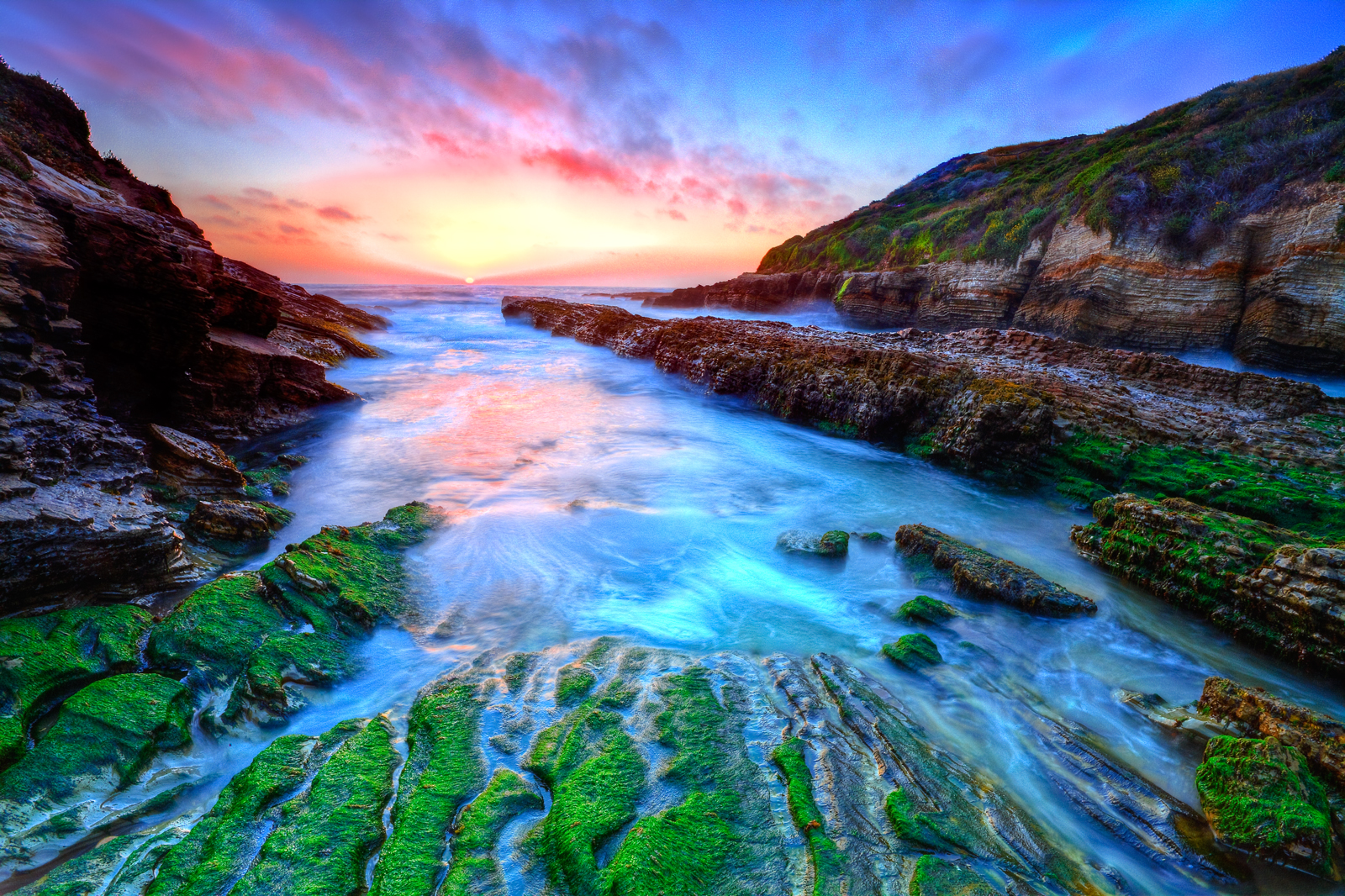
That's right, my "Playa de Verde" image is the Week 9 Winner - California Coast in The Weather Channel's From the Edge with Peter Lik Photo Contest. Peter makes the following comment about my image, "I love the way this shot leads your eye into the horizon. It's a wonderfully composed photograph and I like the contrast between the foreground and the flaring sunlight in the distance. The slow shutter speed works nicely to showcase the movement of the ocean's water. This photograph is very painterly and really speaks to the viewer."  You can watch "From the Edge with Peter Lik"on The Weather Channel, every Thursday at 9 PM EST (8 Central) or 6 PM PST. Also if you happen to catch a re-run of Week 10, you will see my image featured as the last week's photo contest winner.

This image is also my featured image of the month and all Registered users can receive a 20% discount on this image during the month of June 2011.  Not a register user?  Simply click on the Register button in menu of my website, fill out the form, and you will start receiving monthly discount offers, news and updates from Greg Clure Photography.

Sunday, June 5, 2011

Photo Tours Launched by Greg Clure Photography


 Announcing the launch of my Fall 2011 Photo Tours. My Photography Tours emphasize in the field landscape and wildlife image capture in unique locations at prime times of the year. I have made numerous trips to these destinations over the past 25 years. My knowledge of these areas combined with my photography credentials and experience means everyone from novice to expert will get something out of every photo tour. Read more about a specific Photo Tour by clicking on that Tour below:

Friday, May 13, 2011

Principles of Composition

The PRINCIPLES OF COMPOSITION are the rules of grammar of the visual language of photography.  The PRINCIPLES organize the visual elements into a pleasing and comprehensible whole.  This organization is called COMPOSITION.  Our first response to a composition is to perceive it as a whole.  This response is subjective.  Strong images feature many of these PRINCIPLES and/or emphasize a few.

UNITY is the quality of cohesion that makes an image feel complete or whole. Photographers achieve unity by using consistent methods to reveal the meaning, purpose, and/or the intention of their images.  Distinctive ways of creating unity are often identified as artistic styles.

BALANCE refers to the distribution of visual weight in an image. "Empty" areas should not appear to be blank. Instead, they should represent void, or negative space.  Likewise, positive shapes and forms should not appear to be too crowded, heavy, or busy. Balanced images may suggest motion, but it should not appear to be so unstable as if to suggest it would hang crooked.

MOVEMENT or visual movement is used by photographers to direct the scanning behavior of the eye along a circuit or path within an image. This circuit leads the viewer to areas of visual interest, focus, and/or emphasis.  Motion is suggested by the action line of the subject in an image. The action line moves in the apparent direction that the subject is moving or looking.

RHYTHM is the sequencing or repetition of visual movement presented by the composition of visual elements: colors, shapes, lines, tones, forms, and textures. Variation and contrast keep rhythm interesting and dynamic.

FOCUS is the emphasized form or area which draws attention and reveals the subject, central idea, or theme of an image. Emphasis is often achieved by using rhythm and movement to lead the eye to an element that is unique, or has a contrasting tones, shapes, sizes, or colors. Focus and contrast are the same principles as emphasis and variety. In photography, selective focus can be optically achieved with our lens.

CONTRAST is the organized interplay of visual differences which provides variety and stimulates visual movement. Contrast refreshes the eye and enables the viewer to better perceive and evaluate the relationships between the visual elements.

PATTERN is a system of elements which creates a recognizable sequence of repetition. Pattern may also be thought of as the underlying structure, concept, or plan, that organizes the image. Nature is full of natural patterns.

PROPORTION refers to relationships of size and form between the whole and it's parts. Although proportion can often be mathematically measured and described, it can also be compared to one's expectations of natural or ideal form. Proportion is usually related to size and scale. Proportion often influences the emphasis of an image, and our sense of space.

Composition reflects intention. By knowing and applying or choosing to break these PRINCIPLES OF COMPOSITION you can capture better images. While a lot of thing can be easily corrected in today's digital world in post production, composition generally cannot. Outside of cropping, you are stuck with what you captured when you snapped the shutter. Good compositions can be manipulated to become better and bad compositions will never improve to a point of becoming good.

Monday, May 9, 2011

Two Finalist in the Latest Outdoor Photographer Photo Contest

You have until May 18th to vote for my two entries in the latest Outdoor Photographer Magazine's 2nd Annual Great Outdoors Photo Contest.  This is the first time I have had two entries make it into the pool of Finalists for an Outdoor Photographer Photo Contest. It is tough enough to just get one, so I am honored to have two. You vote by assigning stars to each photograph, with 5-stars being the best.  Please vote!


Please go to both pages below and cast your 5-star vote.  Thank you for voting!
  1. http://www.outdoorphotographer.com/photo-contests/2nd-annual-the-great-outdoors/finalists/412231-inky-waters.html#gal-img
  2. http://www.outdoorphotographer.com/photo-contests/2nd-annual-the-great-outdoors/finalists/412131-pipeline.html#gal-img

Monday, March 28, 2011

Elements of Composition - Part II

This is a continuation of my Elements of Composition discussion--Part I of this entry was posted on February 24, 2011. In Part I, I discussed the first six of twelve elements of composition and I continue that discussion with the second six elements.
  1. PRINT PRESENTATION - The image should be able to stand on its own. Ask your self, "Would I hang this image on my wall?" If not, you need to find another subject, better light, more elements of composition, etc. to move your answer to yes. Not to say you should not take a shot that you won't hang on your wall, as there are many reasons to do so. I often take what I call documentary shots or snap shots as a means of noting a location that I plan to return to in more favorable conditions.
  2. CENTER OF INTEREST - This is where the photographer wants the viewer to concentrate the eye. You will use many of the elements of composition discussed here to help the viewer move through your image and land on and stick to your center of interest. That interest may or may not be a specific subject within your composition but it may be the light, a pattern or color of the image.  All can be strong centers of interest and every thing you do should direct the view to this center.
  3. SUBJECT MATTER - Is your subject clean and distinct? What you exclude from your image maybe just as important as what you include. Keep it simple and do not include conflicting subjects. The simpler the scene the easier it is for the viewer to see your subject. A shallow depth of field is often used to isolate the subject in a scene.
  4. COLOR BALANCE - does the image accurately reflect the colors you saw when you snapped the shutter? Good harmony between colors will enhance your image.  An orange sun against a blue sky adds a warm/cool color contrast which appears to darken the blue sky and intensify the orange glow of the sun.  This is no accident as these colors are exact opposites (complementary) on the color wheel as are green/red and yellow/violet combinations. If your image includes a person, their skin tone should be the focus of your color balance efforts. People know what good skin tone looks like and when its off its an immediate distraction.
  5. TECHNIQUE - or the approach used to create the image.  Were the art principles adhered to when creating your composition.  You must first know the rules of good composition if you plan to break them and succeed. In most cases breaking the rules results in a less desirable composition, but their are occasions where a better image can be created by breaking one or more of these rules.  A good example of this may be a reflection where you place your horizon line across the center of the image to emphasis the symmetry of the scene.
  6. STORYTELLING - is your images' ability to evoke the viewer's imagination. Flowing water is often shot at slow shutter speeds to evoke a sense of motion. The viewer can easily imagine water running through a stream or down a water fall and evoke the imagination into hearing what the scene may have sounded like. If a picture is worth a thousand words, what words do you want your viewer to hear?
Put these element to work for you in your photography and you will be pleasantly surprised at their ability to enhance your imagery. Again, I hope you found this information useful and I encourage you to leave your comments below. Also, should you have suggestions on future discussion topics, please feel free to leave those in the comments as well.